
Blog · fractions
Operations With Fractions: Add, Subtract, Multiply, Divide
· AI Math Tutor Team
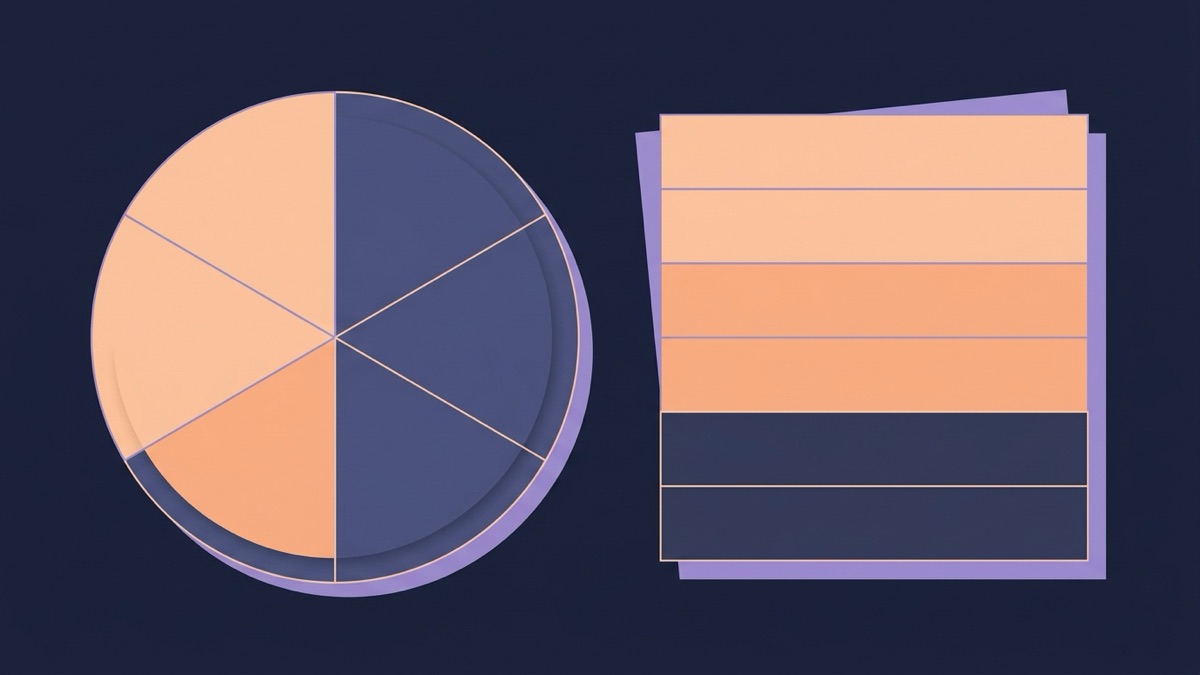
Operations with fractions, adding, subtracting, multiplying, and dividing, each follow their own rule, and mixing those rules up is the single biggest reason fraction homework goes wrong. The good news is that once you know which rule belongs to which operation, you can work through any fraction problem without guessing. This guide covers all four operations with fractions in order, including mixed numbers, gives you a table to check your rule against, and walks through four worked examples so you can see each rule in action. Whether the problem comes from a worksheet, a recipe, or a step you got stuck on while working through algebra, the same four rules apply every time.
Key takeaways
- Adding and subtracting fractions requires a common denominator; multiplying and dividing do not.
- Multiplying fractions means multiplying the numerators together and the denominators together, then simplifying.
- Dividing by a fraction means multiplying by its reciprocal, the fraction flipped upside down.
- A mixed number needs to become an improper fraction before any of the four operations, and can convert back to a mixed number once you have your answer.
- Simplifying your final answer, and checking it a second way, catches most fraction mistakes before they become a wrong answer.
Why fractions need a different rule for each operation
A fraction describes equal parts of a whole, and the denominator tells you how big each part is. Addition and subtraction only make sense when the pieces you are combining are the same size, which is exactly what a common denominator guarantees. Trying to add and directly would mean adding quarters and sixths as though they were the same size piece, which they are not.
Multiplication and division work differently because they are not about combining pieces of the same size. Multiplying by asks for a part of a part, a sixth of a quarter, and that calculation does not care whether the two denominators match. This is the reason the four operations with fractions feel like four separate skills at first, even though they all use the same numerator and denominator you already know from How Do Fractions Work? Numerators, Denominators, Wholes.
Picture it with an actual pizza. If you have of one pizza and someone hands you of a different pizza, you cannot say how much pizza you have just by looking at the numbers 4 and 6, because a quarter slice and a sixth slice are not the same size. Multiplication asks a different question entirely, such as what a third of a half is, and that question never depended on the two denominators matching in the first place. That difference in what is actually being asked is why addition and subtraction need a shared denominator while multiplication and division do not.
Adding and subtracting fractions
To add or subtract fractions, first find a common denominator, a number that both denominators divide into evenly. The least common multiple of the two denominators is the smallest number that works, though any common multiple will do.
Once both fractions share a denominator, rewrite each fraction using that denominator by multiplying its numerator and denominator by the same number. Then add or subtract the numerators and keep the denominator the same. becomes once both fractions share the denominator 12.
Subtraction works the same way, with one extra wrinkle for mixed numbers: if the fraction part you are subtracting is larger than the fraction part you are subtracting from, you need to borrow a whole from the whole-number part first, the same way you would borrow a ten in ordinary subtraction.
Finding a common denominator without guessing
The fastest common denominator to use is the least common multiple, or LCM, of the two denominators: the smallest number both denominators divide into evenly. For small denominators, you can often spot the LCM by listing multiples. The multiples of 4 are 4, 8, 12, 16, and the multiples of 6 are 6, 12, 18, and the first number that shows up on both lists is 12, so 12 is the LCM of 4 and 6.
For larger denominators, breaking each one into prime factors is more reliable than listing multiples. To add and , factor and , then build the LCM from the highest power of each prime that appears in either factorization: . Any common multiple of the two denominators works as a shared denominator, even the plain product of the two numbers, but the LCM keeps the numbers in the problem as small as possible, which means less simplifying once you reach an answer.
Multiplying fractions
Multiplying fractions is the most direct of the four operations. Multiply the numerators together to get the new numerator, multiply the denominators together to get the new denominator, and simplify the result. , which simplifies to .
You can also cancel common factors before multiplying, which keeps the numbers smaller. In , the 3 in the first denominator and the 3 in the second numerator cancel, leaving directly, the same answer without an extra simplifying step at the end.
Dividing fractions
Dividing by a fraction means multiplying by its reciprocal, the fraction turned upside down. To divide by , keep as it is, flip to , and multiply: .
This works because dividing by a number and multiplying by its reciprocal are always the same operation, whether the number is a whole number or a fraction. Dividing by 2 is the same as multiplying by , and dividing by is the same as multiplying by for exactly the same reason.
One way to see why flipping and multiplying works is to think about what division is actually asking. Dividing by asks how many groups of fit into the amount you started with, and multiplying by answers exactly that question. It also explains why dividing by a fraction smaller than 1 gives you an answer larger than what you started with: fitting small groups into an amount takes more groups, not fewer.
Mixed numbers in the four operations
A mixed number, like , combines a whole number and a fraction. Before you add, subtract, multiply, or divide a mixed number, convert it into an improper fraction: multiply the whole number by the denominator, add the numerator, and place that result over the original denominator. becomes , since .
Once every mixed number in the problem is an improper fraction, apply whichever of the four rules the operation calls for exactly as you would with any other fraction. At the end, if the problem asks for a mixed number, divide the numerator by the denominator to find the whole-number part, and write what is left over as the fraction part. For a full walkthrough of adding and subtracting mixed numbers, including the borrowing step, see Mixed Fraction Addition and Subtraction, Step by Step.
Dividing by follows the exact same pattern. Convert to , then multiply by the reciprocal of , which is 4: . The mixed number never needed a special rule of its own; it only needed to become an improper fraction before the division rule took over.
Simplifying and checking your final answer
Every one of the four operations can leave you with a fraction that still has room to simplify. Find the greatest common factor, or GCF, of the numerator and denominator, the largest number that divides both evenly, and divide both by it. has a GCF of 12, so it simplifies to .
A quick way to check any fraction answer, whichever operation produced it, is to convert the original numbers and your answer to decimals and see whether the arithmetic lines up. should land close to , and if your fraction answer converts to something far from that, it is a sign to look back through the steps. This decimal check does not replace the fraction rules themselves, but it catches the kind of slip, a flipped numerator, a missed simplification, that is easy to overlook when you only look at the fraction on the page.
The four operations at a glance
| Operation | Rule | Example |
|---|---|---|
| Add | Find a common denominator, add the numerators, keep the denominator | |
| Subtract | Find a common denominator, subtract the numerators, keep the denominator | |
| Multiply | Multiply the numerators, multiply the denominators, then simplify | |
| Divide | Multiply by the reciprocal of the second fraction |
Worked examples
Example 1: add
- Find a common denominator for 5 and 3. Since they share no common factors, use their product, 15.
- Add the numerators now that both fractions share a denominator.
- Check whether can simplify further. Since 11 is prime and does not divide 15, it is already in simplest form.
So . Check it by estimating: is a little less than a half and is about a third, so a sum a little more than two thirds, like , is exactly what you would expect.
Example 2: subtract
- Convert both mixed numbers to improper fractions.
- Find a common denominator for 4 and 3, which is 12, and rewrite both fractions.
- Subtract the numerators.
- Convert the answer back into a mixed number.
So . Check it by estimating in decimals: is and is about , and , which matches .
Example 3: multiply
- Convert the mixed number to an improper fraction.
- Multiply the numerators together and the denominators together.
- Simplify the result.
So . Check it by estimating: three quarters of a number close to should land a bit below , and 2 fits that estimate.
Example 4: divide
- Keep the first fraction the same and flip the second fraction to its reciprocal.
- Multiply the numerators and the denominators.
- Simplify by dividing the numerator and denominator by their greatest common factor, 3.
So , or . Check it by multiplying the answer by the divisor: , which matches the original problem.
Common mistakes
- Adding or subtracting fractions without first finding a common denominator, which gives a numerator and denominator that do not mean anything together.
- Forgetting to convert a mixed number into an improper fraction before multiplying or dividing it.
- Flipping the first fraction instead of the second when dividing.
- Simplifying only the numerator or only the denominator instead of dividing both by the same common factor.
- Multiplying the denominators when the operation was actually addition or subtraction, mixing up the rules for the two groups.
If the numerator and denominator still feel like two unrelated numbers, start with How Do Fractions Work? Numerators, Denominators, Wholes before coming back to these four operations. When a fraction shows up in an unfamiliar form partway through a problem, Equivalent Fractions: Examples and How to Find Them shows how to recognize it as the same value. And for a method that works on any kind of problem, not only fractions, see How to Solve Any Math Problem Step by Step. When you want a fraction problem checked line by line, scan it and read every step in AI Math Tutor.
AI Math Tutor is a study aid, not a substitute for a teacher, and it can make mistakes: check every step, not just the answer.
Questions
Do all four operations with fractions need a common denominator?
No. Adding and subtracting fractions requires a common denominator, but multiplying and dividing do not. Those two operations work directly on the numerators and denominators you already have, then simplify at the end.
How do you divide one fraction by another?
Keep the first fraction as it is, flip the second fraction to its reciprocal, and multiply the two. Dividing by is the same as multiplying by .
What do you do with a mixed number before adding, subtracting, multiplying, or dividing it?
Convert it to an improper fraction first, then apply the operation's normal rule. Once you have your final answer, convert it back to a mixed number if the problem calls for one.
Why do fractions multiply straight across but not add straight across?
Multiplying fractions combines a part of a part, so the numerators multiply together and the denominators multiply together directly. Addition combines pieces of the same size, so the pieces need to match first, which means the denominators need to match before the numerators can be added.
How do you know a fraction answer is fully simplified?
Check whether the numerator and denominator share any common factor other than 1. If they do, divide both by their greatest common factor. If the only shared factor is 1, the fraction is already in simplest form.